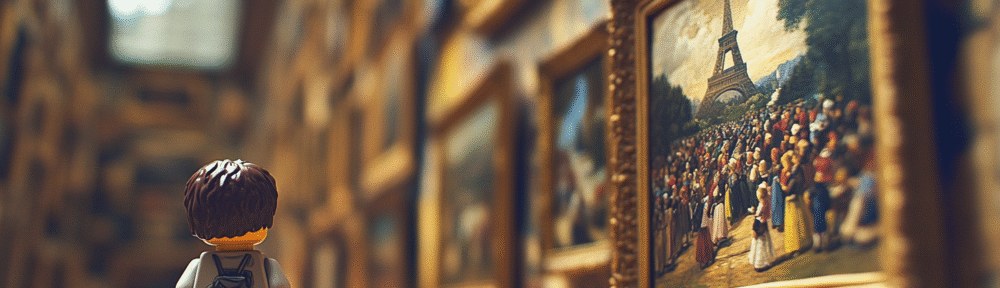
I didn’t plan to get into minifigs. That part just sort of happened. One day I was painting detailed fantasy art; the next, I was hunched over a tiny plastic head, trying to get eyebrows to match. Weird, right? But it makes sense if you know how my brain works.
It Started with a Sharpie
My first “custom” minifig was a LEGO knight with a mustache I drew on using a red Sharpie. I was maybe nine. And honestly? It looked awful. But I was proud of it. I had changed something. It wasn’t just a LEGO knight anymore—it was my LEGO knight. That feeling stuck.
Years later, I got into digital art and painting. I started posting on my blog and sharing stuff that felt more serious, more “real.” But part of me always liked small things. Toys. Models. Objects you can hold in your hand. They feel more personal somehow.
Why Minifigs?
I like constraints. When you have to design a character using a tiny torso, fixed arms, and a weird cylindrical head, it forces you to make strong choices. You can’t rely on nuance or subtlety. You have to commit. That’s a good challenge for any artist.
And there’s the nostalgia factor. Everyone knows what a LEGO minifig looks like. That shape is instantly recognizable. So when you mess with it—when you make it into something unexpected—people notice. It sticks in their brain. I think that’s why I enjoy it.
Plus, they’re just fun. There’s no better word for it.
My Process (or Lack of One)
I don’t follow some rigid workflow. Sometimes I start with a character I like. Other times it begins with a color palette or a dumb pun that makes me laugh. There are days when I’ll spend hours trying to get a specific shade of green to print properly. Then there are days where I just wing it and somehow it turns out great. (Don’t ask me why. Art is like that.)
Most of the time, I sketch a quick concept on paper or in Procreate. I think better with a pencil or stylus in hand. Once the idea is solid, I move to Illustrator to lay out the print layers for the head, torso, and legs. Then it’s a matter of testing, adjusting, reprinting, cursing when the white doesn’t show up right, and starting over.
What Makes a Good Minifig?
It needs a spark. That’s the best way I can say it. You look at it and something just clicks. Maybe it’s a character you recognize. Maybe it’s just a weird vibe that feels familiar. I made a minifig of a possum in a hoodie once. No joke. And it sold out in a day. Why? I have no idea. But it had that spark.
I try to balance detail with readability. Too much fine detail and it becomes a blurry mess at that scale. Too little, and it looks lazy. There’s a sweet spot. You only find it by doing.
Tying It Back to My Art
If you look at my paintings and then look at my minifigs, you might not see an obvious connection. But it’s there. It’s in the characters. The expressions. The weird mix of humor and melancholy that I can’t seem to stop putting into everything.
A lot of my paintings feature characters who are a little out of place. Same with the minifigs. I think that’s the thread. I’m drawn to stories about people (or animals, or aliens) who are stuck between worlds. That shows up whether I’m using a brush or a UV printer.
The Technical Stuff (Short Version)
For those who care: I use a combination of UV printing and pad printing, depending on the design. UV is faster and more flexible. Pad printing gives a more “official LEGO” look. I design everything in vector. I print in small batches because I want each run to feel special. And yes, I do all the printing myself. I’m not outsourcing this stuff to some factory in another country. It’s just me, in my studio, covered in plastic dust.
The Frustrations
Sometimes the printer jams. Sometimes the ink doesn’t cure. Sometimes a batch of heads arrives and every single one is off-center. I have learned to embrace chaos. It’s part of the deal. I used to get mad. Now I just sigh, take a break, and start again.
Art isn’t always smooth. Especially when it’s applied to a 1.5-inch toy.
Why I Keep Doing It
Because people like them. Because I like making them. Because they make me laugh. Because I’ll never run out of ideas. Because sometimes someone buys one and sends me a photo of it on their shelf, and that’s the best feeling in the world.
I don’t think these little figures are going to change the world. But they can brighten a desk. Or start a conversation. Or make someone smile for half a second on a bad day. That’s enough.
Where to Find Them
While I only make a small batch of my own custom figures, sites like minifig.biz are a great place to browse for inspiration. You’ll find everything from obscure references to clever mashups—and who knows, maybe something on there sparks your next build.
Now if you’ll excuse me, I have to fix a batch of heads with misaligned eyeballs. Again.